
Catch Me if I Fall

Two things on my mind this week.
Here’s my radio show from Saturday featuring the likes of Love Tractor, Bruiser Wolf, and Illuminati Hotties:
Black Fucking Midi
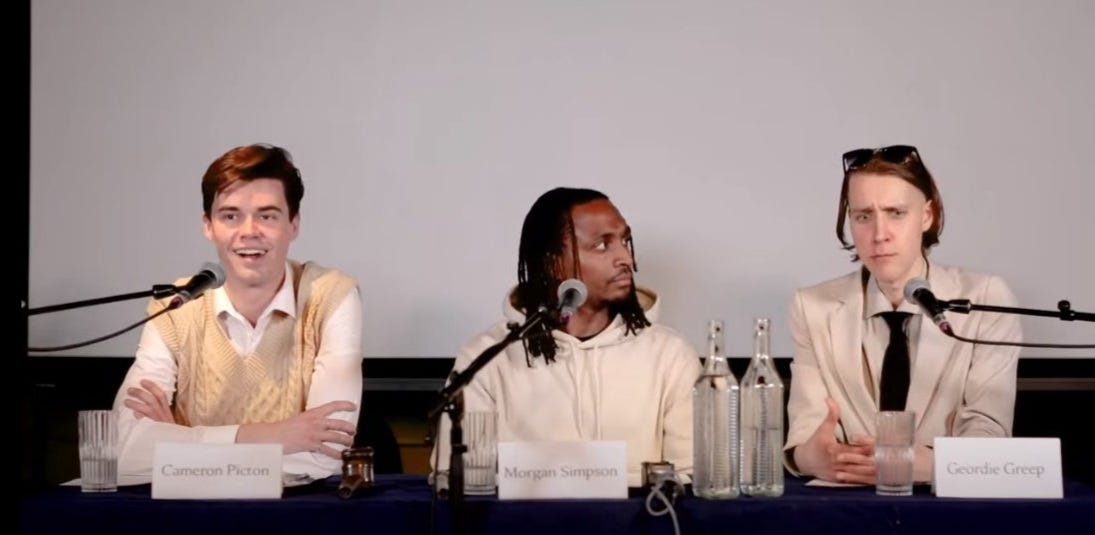
Black Midi, man. What to even say about this? You can have more fun coming up with stupid tweets about it than practically anything else. (It’s like if Zappa made the score to Metropolis!) There are moments in their music that are so black midi. Singer Geordie Greep (real name (damn brits)) sits comfortably amongst a fuzzy cloud of insane chaos muttering some nonsense as if nothing is happening. Drummer Morgan Simpson gets bored of whatever shape he’s playing so he does this delayed triplet thing in slow motion to just pull the band into a completely different zone. The opening to their debut album is gnarled metallic guitars so disgustingly mangled that you have to take a look at the chaotic album cover to maintain a sense of peace. Their sophomore effort is fittingly insane and maintains much of what’s to love, but somehow, surprisingly, it manages to jam in a sense of warmth?
Case and point: the song titled “Marlene Dietrich.” This is like Black Midi’s attempt at some long lost interlude in Cabaret or something. There’s like…string swells on this album. Greep’s voice maintains its lovingly ridiculous aura so, you know its still midi, but there’s not too many bands who can write a love letter to Mrs. Dietrich so straight-faced and make it sound both sarcastic and cool.
Even the sort of archetypical “Chondromalacia Patella” which follows has a little smolder to it. After saxophone squelches open the thing, they’re into cool bass tones and meditative guitar strumming to let things simmer before the eventual explosion. “Diamond Stuff” is the most mysterious of all as a sea of pizzicato strings provide a heart beat backing to this extremely jarring combination of Geordie ramble and (dare I say) major chords? Of course this was how it had to play out. You can’t launch a rocket into the music discourse as your debut without then following up with a launched rocket straight at your own formula.
The second half revs up a bit more. The one two punch of “Dethroned” into “Hogwash and Balderwash” barrel down the freeway in a distinctly black midi fashion. Then “Ascending Forth” attempts some final 10-minute summation of the whole album based around a stupid music theory joke accompanied equally by beautiful strings and screeching saxophones.
It’s fitting that the cover to this album is a vivid mash of colors. The added strings and horns give a serious technicolor edge to a band that's emotionally distant to say the least. Where will they go next? Hopefully somewhere you can’t imagine.
Out of Time
Well, here we are. R.E.M’s world conquering commercial breakthrough. I have to be honest, I think this album is really fascinating because as a teenager who was oddly obsessed with the 90’s alt-rock station on Sirius XM, I always took it for granted as this exemplary alt-rock exercise. When I listen to this now, I’m more like “what else is like this?”
Of course, part of this is when you grow up and learn more about history, you understand that the easy narratives aren’t so easy. 1991 is often described as the year that grunge broke and darker music on the whole started to take over. Seattle alone offered us Ten, Badmotorfinger, and Nevermind that year and Metallica’s Black album famously scored number 1 on Billboard.
There’s certainly some weight to this because it was somewhat unheard of that a (non-hair) metal band could reach these heights and I’m sure many people on just a personal cultural level felt like some sort of sea change was happening. Still, can you guess who actually spent the most time at the top of the charts in 1991? Mariah Carey. You know who else was close? Garth Brooks. Nevermind didn’t even hit number 1 on Billboard until 1992.
It’s also been mentioned time and time again by critics that the music industry just kind of lumped all of Seattle together for ease of marketing rather than due to the actual sound of the bands. A model that one might compare to, say, Athens, Georgia in the early 80’s. I agree to some extent. Soundgarden was way more concerned with playing weird time signatures than Nirvana, who mostly seemed to want to show the world the Raincoats and Sonic Youth. Still though, that grimy 90’s production and gruff vocalizations are some serious dead giveaways for 90’s studio work. Can you say the same of “Near Wild Heaven?”
Let’s talk about “Losing My Religion.” MTV mainlined this as soon as it came out, which is arguably the reason the song is overplayed to so many music fans. But aside from that, what is 90’s about it? I would argue the video more than the music. It’s pretty easy to start listing other 90’s videos of distraught men reckoning with life’s truths. Or maybe getting disillusioned with certain systems they were supposed to be enthusiastic about. But basically all of these bands did this with grimy guitar sounds, not the fucking mandolin. (IF a band WERE interested in the mandolin, they weren’t singing about how the world had lied to them for sure).
Now, maybe I’m contradicting myself because at the start of this whole project I said that R.E.M. interested me because they survived the 90’s and were able to operate as an alt-rock band and as an 80’s college rock band (and as a cool enough band to continue booking plenty of gigs in the aughts). Part of it is that R.E.M. was so masterful at hiding unexpected turns in plain sight. You might get the idea from their 80’s singles that they were doing strictly chorus-verse-chorus sprightly pop tunes, but that’s not entirely the case. At a glance “Man on the Moon” and “Losing My Religion” signal such deep 90’s feelings and yet I think they’re a little bit more complicated.
This brings me to the final trio of songs on this album, one of the strongest runs of the band’s career. I think it’s useful to look into these tunes as a microcosm of the whole thing because the album is admittedly a bit weirdly sequenced and imperfect. The KRS-One feature on “Radio Song” is cool and well meaning, but it sounds more like the band is poking fun at the DJ personalities of Hip-Hop radio rather than presenting a general diatribe about the dangers of mass media. I don’t hate “Shiny Happy People,” but I get it and “Low” kind of doesn’t fit. “Near Wild Heaven” is astonishing and it signifies what the whole of the album sounded like more than much of the front half.
Anyways, the last three songs—what do they tell us about Out of Time. Well first of all, the other Mike is singing “Texarkana” and B-52’s Kate Pierson is half of “Me in Honey.” Giving themselves more of a leash in the studio, Out of Time was R.E.M’s most expansive sounding record thus far. It’s all wide open spaces westerns and tales from the edge. If Document had Cassette tapes in mind, Out of Time is certainly an all-time CD listen.
Though small, it’s kind of interesting to look at the Mike Mills lyrical world. He wrote “Rockville” from Reckoning about some girl he wanted to stick around Athens with him for the summer and on his two OOT songs he gives more nuanced tales of human connection. “Near Wild Heaven” is a bright take on a relationship about to fall apart and then “Texarkana” is seemingly about finding nirvana with a partner there to help him make it; “Catch me if I fall,” the chorus demands. The band’s primary workflow was Michael Stipe gets the instrumental and writes the lyrics over them, but that’s not the entire story. I think it’s a testament to their chemistry that they were able to work some Mills singing into their world so seamlessly and whenever Stipe is singing sweetly to a partner or lover it makes me wonder “hey maybe the other Mike had a hand in this one.”
Next up is “Country Feedback.” This one’s a little bit more in line with the old R.E.M. as it’s lyrically ambiguous. “It’s crazy what you could’ve had/I need this” is the chorus. Part of me wants to say this is from the perspective of the woman who gets an abortion to the dismay of the man who got her pregnant on the following song. There’s this other lyric “these clothes don’t fit us right and I’m to blame” and I think you could see how it depicts a relationship gone south that needs some kind of closure despite the fact that it had almost been cemented with the creation of life. Other parts are still a little out there. What’s this about: “A paperweight, a junk garage, a winter rain, a honey pot/Crazy, all the lovers have been tagged.” “Me in Honey” is my personal favorite here. I love the chugging guitars and the way Michael and Kate play off each other. It’s a fittingly gorgeous end to this work.
In the end Out of Time isn’t a break-up album per-say. Rather, it’s an album about how there can be disconnect in even our most cherished relationships. I think that’s why “Shiny Happy People” works in the end. It’s easy to approximate closeness and present some sort of communal joy but the question of whether its been truly achieved always lurks beneath the surface.
-Donovan Burtan